Generic prescriptions make it easier for health practitioners to meet patients’ needs, as prescribing a specific brand name can be inconvenient. The prescribed product might be unavailable, or the brand’s dosage form might not suit the patient. In this post, we will look into Medicare Part D data from a generic vs. brand perspective by comparing overall spending, utilization, and cost per prescription.
The following six drug markets are used in the analysis:
| Generic Name | Brand Names |
|---|---|
| Atorvastatin Calcium | Lipitor, Atorvaliq |
| Metoprolol Succinate | Toprol XL, Kapspargo Sprinkle |
| Gabapentin | Gralise, Neurontin |
| Sertraline HCl | Zoloft |
| Amlodipine Besylate | Norvasc, Norliqva |
| Pantoprazole Sodium | Protonix, Protonix IV |
Total Medicare Part D Spending:
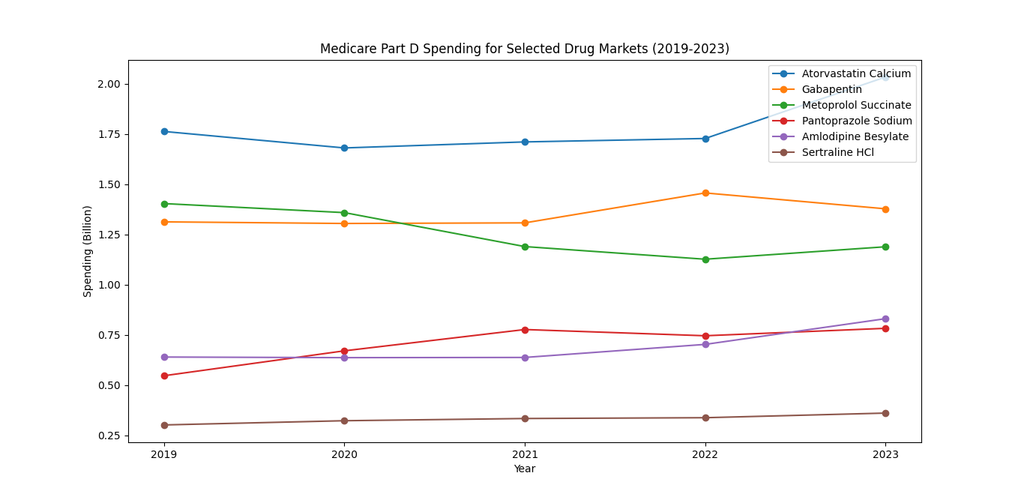
The above figure shows overall spending for each drug market, including generic and brand names. Atorvastatin Calcium leads the chart, with spending rising from above 1.7 billion in 2019 to more than 2 billion in 2023. Gabapentin shows a changing spending trend throughout the years, with its total spending in the final year at around 1.4 billion. Metoprolol Succinate declined from 1.4 billion in 2019 to 1.1 billion in 2022. In 2023, spending slightly increased to approximately 1.2 billion.
Pantoprazole sodium increased from 547 million to 777 million from 2019 to 2021. Spending declined to 747 million in 2022. However, 2023 shows the maximum increase, with overall spending around 784 million. Amlodipine Besylate spending initially decreased from 640 million in 2019 to 637 million in 2020. The line chart shows an increase in spending over the next few years. The total spending in 2023 is around 831 million. Sertraline HCl shows consistent growth over the years. Its spending increased from around 302 million in 2019 to 361 million in 2023.
Utilization Trend for Selected Drug Markets:
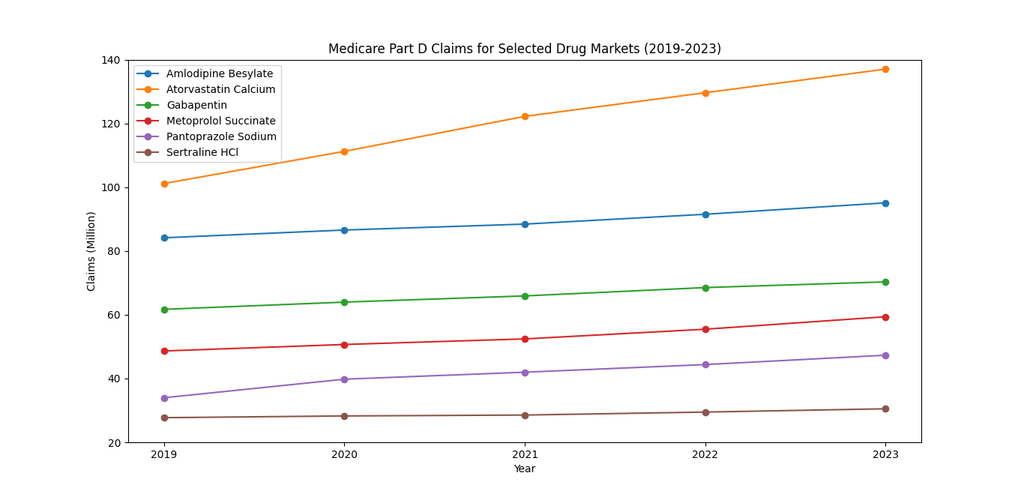
The above line chart shows the change in total claims for selected drug markets over the years. All six drug markets show an increasing trend over the years. Atorvastatin calcium leads the chart, with claims rising from 101 million in 2019 to 137 million in 2023. Amlodipine besylate claims increased from 84 million to around 95 million. Gabapentin claims increased from around 62 million to 70 million over the years.
Metoprolol Succinate claims increased from around 49 million to 59 million. Pantoprazole Sodium claims rose from 34 million in 2019 to 47 million in 2023. Sertraline HCl shows a relatively smaller increase in claims, from 28 million to around 31 million.
Cost Per Prescription:
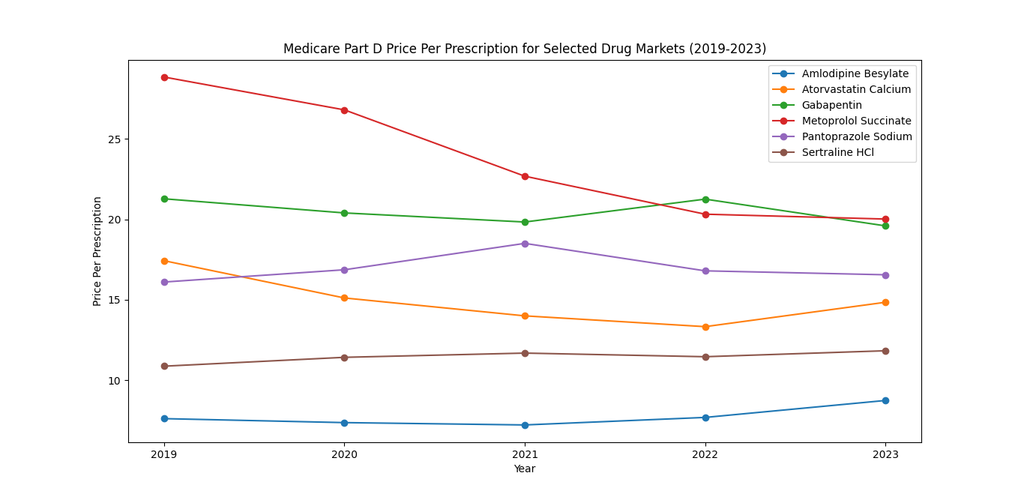
The cost-per-prescription chart for all six markets shows Metoprolol Succinate in first place, although its price declined throughout the study period. Its price decreased from $28.9 in 2019 to $20 in 2023. Gabapentin shows a varying trend, with its cost declining from $21.3 in 2019 to approximately $19.8 in 2021. Its price rose to $21.3 in 2022. In 2023, its cost was around $19.6.
Pantoprazole Sodium cost increased from $16.1 in 2019 to $18.5 in 2021. The dip indicates a price reduction in subsequent years, i.e., $16.8 and $16.6 in 2022 and 2023, respectively. Atorvastatin Calcium shows an inconsistent cost-per-prescription trend. Its cost declined from $17.4 in 2019 to $13.3 in 2022. In 2023, its price rose to $14.8.
Sertraline HCl price varied throughout the years. Its price increased from $10.9 in 2019 to $11.7 in 2021. The cost slightly declined to $11.5 in 2022, increasing to $11.8 in 2023. Amlodipine besylate followed a similar pattern, with its price decreasing from $7.6 in 2019 to $7.2 in 2021. Its price increased to $7.7 and $8.7 in subsequent years.
Generic vs. Brand Utilization:
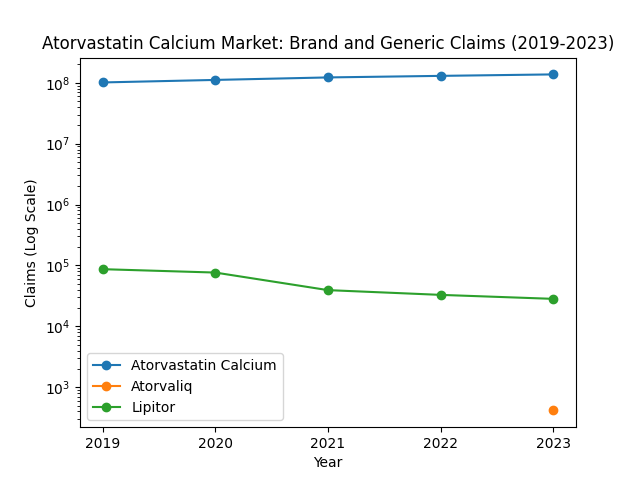
The line chart compares generic Atorvastatin Calcium and two of its brands: Atorvaliq and Lipitor. A log scale was used to accommodate the huge difference between generic and brand claims. Generic claims increased from 101 million to 137 million. Lipitor’s claims decreased from around 87 thousand in 2019 to approximately 28 thousand in 2023. This could be linked to the expiry of its patent and exclusivity rights by June 2020, as the graph shows a sharp decline after 2020. FDA approved Atorvaliq in February 2023, which explains the small number of claims, i.e., 416 in 2023.
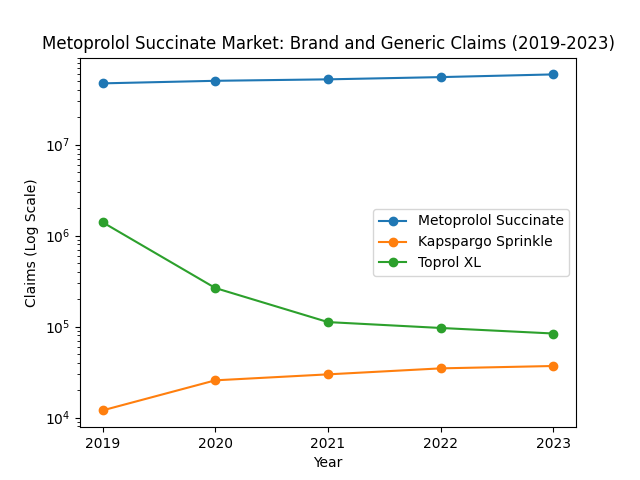
Metoprolol Succinate generic claims increased from 47 million in 2019 to around 59 million in 2023. Its brand product, Tropol XL, shows a steady decline in claims from 1.4 million in 2019 to around 84 thousand in 2023. Its patent rights expired in 2006. So, the claims are not associated with the patent’s expiry.
Kapspargo Sprinkle showed a steady rise in claims from around 12 thousand in 2019 to 37 thousand in 2023. This could be linked to patent rights protection, as its patents will expire in 2035.
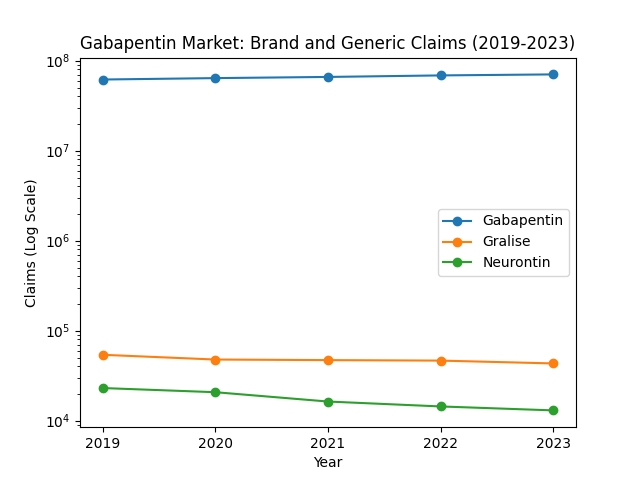
Gabapentin generic claims increased from around 62 million in 2019 to about 70 million in 2023. Grailse claims declined from around 53 thousand in 2019 to 43 thousand in 2023. Interestingly, its patent rights expired in 2022. However, some exclusivities existed till 2024. Thus, the decline in claims couldn’t be directly linked to the patents. The impact will be visible from 2025 onwards. Neurontin claims decreased from 23 thousand in 2019 to around 13 thousand in 2023. Its patent rights expired in 2022. However, the decline remained consistent. These findings suggest that the decrease in Gabapentin brand claims is not linked to patent rights protection.
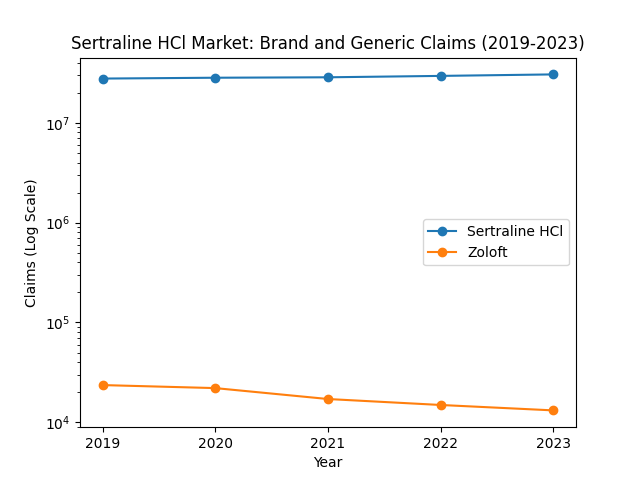
Generic claims for Sertraline HCl increased from around 28 million to 30.5 million over the years. Unlike other drug markets, Zoloft is the only brand in the Medicare Part D coverage program. Zoloft claims declined from around 24 thousand in 2019 to 13 thousand in 2023. The line chart shows a relatively steep decline in 2021, which might be linked to its patent expiry in 2020.
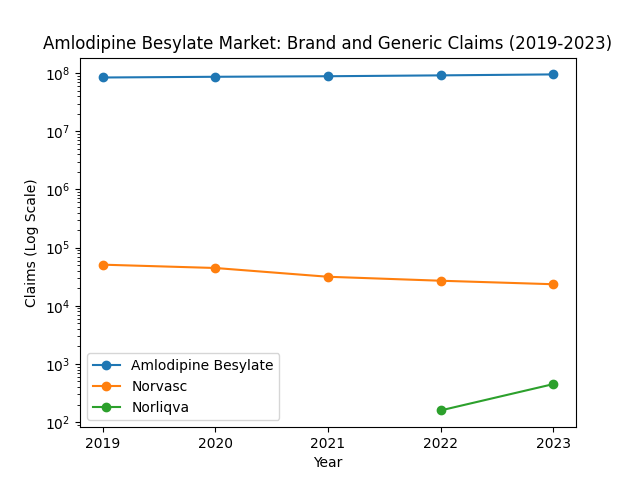
Amlodipine Besylate generic claims increased from around 84 million to 95 million throughout the study period. Norvasc claims declined from about 51 thousand in 2019 to 23 thousand in 2023. Its patents expired in 2007. Hence, the claims are not affected by patent protection. On the contrary, the FDA approved Norliqva in February 2022. So the claims are visible for only two years, i.e., 2022 and 2023. Both years had a small number of claims, i.e., 159 and 451, respectively. Its patents are valid till 2041. So, the data for the upcoming years might show a larger increase in the number of claims.
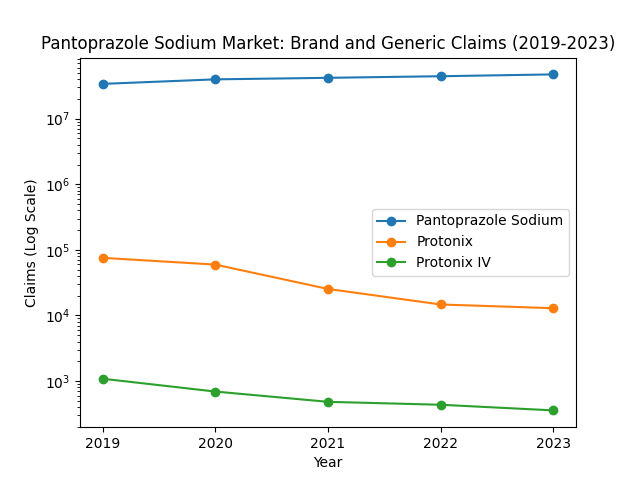
Pantoprazole Sodium generic claims increased from around 34 million to 47 million between 2019 and 2023. Interestingly, the selected brand names are the same, with different dosage forms. Protonix claims decreased from around 75 thousand in 2019 to around 13 thousand in 2023. Its patent rights are active till 2026. Yet, claims are constantly declining. This shows that the patent protection has no impact on the number of claims. Similarly, Protonix IV claims declined from around 1 thousand to 356 over the years. Its patents have already expired, but it has valid exclusivity rights till August, 2027.
These findings lead us to the next question: How has brand product utilization changed over the years?
Brand Product Utilization:
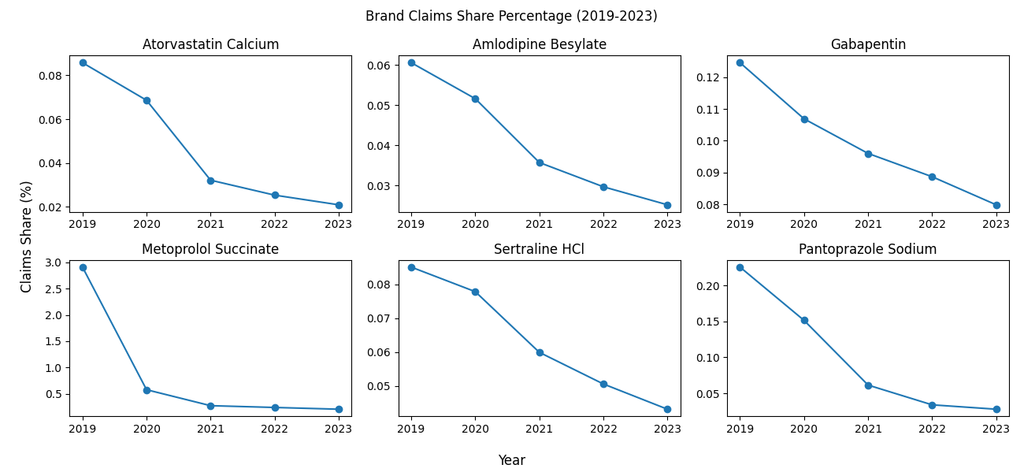
The figure shows claim share percentage for brand products of all six markets from 2019 to 2023. Atorvastatin Calcium brands’ claim share decreased from around 0.09 % to 0.02%. Amlodipine Besylate brands’ claim share decreased from 0.06% to less than 0.03%. Gabapentin brand share percentage decreased from more than 0.12% to 0.08%.
Claims percentage for Metoprolol Succinate brands decreased from 3.0% to 0.2%. Sertraline HCl percentage decreased from more than 0.08% to 0.04%. Pantoprazole Sodium brand claims also declined from more than 0.20% to 0.03%.
These findings reaffirm that brand claims percentage share is declining in all six markets. Thus, generic claims are leading the claims percentage share in all six markets. This raises the question of how these changes in claims percentage affect spending.
Brand Products Spending:
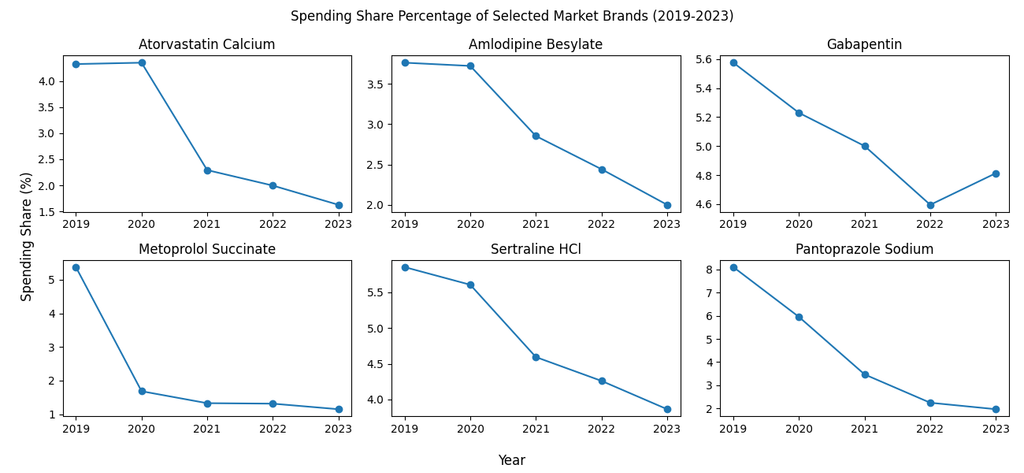
The figure shows the spending share percentage for brand products in selected markets between 2019 and 2023.
Atorvastatin Calcium:
Brand spending share increased from 4.3% in 2019 to around 4.4% in 2020. The line then shows a steady decline in the following years, with the spending share falling to around 1.6% in 2023.
Amlodipine Besylate:
The line chart shows a decline in the brand spending share from around 3.8% in 2019 to 2.0% in 2023.
Gabapentin:
Gabapentin brand products show a varying trend. Spending share percentage declines from approximately 5.6% to 4.6% between 2019 and 2022. The percentage slightly increased to 4.8% in 2023.
Metoprolol Succinate:
The brand’s spending share percentage sharply decreased from 5.4% in 2019 to 1.7% in 2020. The line chart shows a consistent decrease in the following years. The spending share percentage was around 1.2% in 2023.
Sertraline HCl:
The brand’s spending share percentage consistently decreased from 5.9% in 2019 to 3.9% in 2023.
Pantoprazole Sodium:
Pantoprazole sodium also showed a steady decline in spending share throughout the years. Its percentage decreased from 8.1% in 2019 to 2.0% in 2023.
Both spending share percentage and claims share percentage for brand products show similar trajectories. No outliers or anomalies were found. This leads us to investigate the changes in all three parameters throughout the study period.
Percentage Change over the Years:
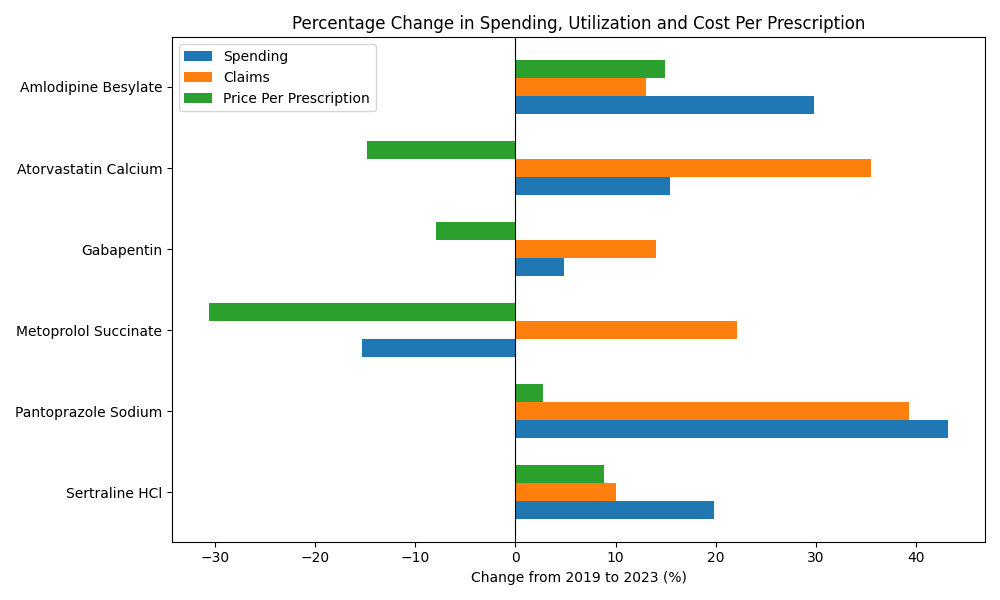
The bar graph shows varying percentage change trends for all six markets from 2019 to 2023. Pantoprazole Sodium showed the largest increase in spending (43.2%), followed by Amlodipine Besylate (29.8%) and Sertraline HCl (19.8%). In contrast, Metoprolol Succinate is the only market showing a decline of about 15.3% in spending.
Utilization percentage increased across all markets, as represented by the number of claims. Pantoprazole Sodium showed the largest utilization increase (39.3%), followed closely by Atorvastatin Calcium (35.5%). Metoprolol Succinate utilization increased by 22.1% over the years.
Gabapentin and Atorvastatin Calcium cost per prescription decreased by 7.9% and 14.8%, respectively, despite rising claims. Metoprolol Succinate showed a similar trajectory, with claims increasing by 22.1% and cost per prescription decreasing by 30.6%.
Amlodipine Besylate and Sertraline HCl percentages increased in all three parameters. Pantoprazole Sodium followed a similar pattern but showed a minimal increase of 2.8% in cost per prescription.
Analysis revealed that utilization increased across all six markets. Spending increased in five out of six markets, while cost per prescription varied, with a reduction in half of the markets. The findings could be summarized as:
| Drug Market | Spending Change | Claims Change | Cost Per Prescription Change |
|---|---|---|---|
| Amlodipine Besylate | +29.8% | +13.0% | +14.9% |
| Atorvastatin Calcium | +15.4% | +35.5% | -14.8% |
| Gabapentin | +4.9% | +14.0% | -7.9% |
| Metoprolol Succinate | -15.3% | +22.1% | -30.6% |
| Pantoprazole Sodium | +43.2% | +39.3% | +2.8% |
| Sertraline HCl | +19.8% | +10.0% | +8.8% |
Conclusion:
The analysis of the selected six markets in Medicare Part D showed varying trends in overall spending, utilization, and cost per prescription from 2019 to 2023. Generic products accounted for substantial utilization across all markets. However, the relationship between generic utilization and overall spending varied for each market. No clear link was found between patent expiry and increased generic claims, as markets showed varying trends.
The analysis further suggests that increased utilization is not attributed to increased spending. For example, Metoprolol Succinate had a 22.1% increase in claims while its spending declined by 15.1%. Similarly, the relationship between cost per prescription and utilization also varied, as seen in examples of Gabapentin and Atorvastatin Calcium. Their utilization increased while cost per prescription declined. These findings emphasize the importance of considering all parameters because no single factor drives the increase in expenditures.
Context is crucial for understanding the analysis. Most of these markets had substantial generic utilization by the start of the study period. So, the analysis describes trends in already established generic markets. The results provide insight into the relationship between generic utilization, spending, and cost per prescription. However, we cannot establish a direct causal relationship between increased generic utilization and patent expiry for brands.
Methodology Appendix:
Data Source:
- CMS Medicare Part D Spending By Drug Dataset (2019-2023)
- FDA Orange Book (Patent Information)
Drug Selection:
- Atorvastatin Calcium
- Lipitor
- Atorvaliq
- Metoprolol Succinate
- Tropol XL
- Kapspargo Sprinkle
- Gabapentin
- Gralise
- Neurontin
- Sertraline HCl
- Zoloft
- Amlodipine Besylate
- Norvasc
- Norliqva
- Pantoprazole Sodium
- Protonix
- Protonix IV
Metrics:
Total Spending: Sum of annual spending for selected markets.
Brand Claims Share Percentage:
Brand Spending Share Percentage:
Cost Per Prescription:
Utilization: Sum of claims per year.
Percentage Change:
Limitations:
- The analysis includes only a selective population enrolled in the Medicare drug coverage program from 2019 to 2023.
- This is a descriptive analysis and doesn’t establish causal relationships between various metrics.
- The selected markets were not necessarily observed immediately before and after generic entry.
- Generic-entry timing and commercial availability might differ from regulatory approval dates and from the first appearance of products in CMS data.
- Product classification/grouping can affect brand-versus-generic comparisons.
- Percentage changes compare endpoints and do not capture all intermediate-year dynamics.
Leave a Reply