The Inflation Reduction Act (IRA) has made headlines in recent years. It aims to provide relief by changing how Medicare Part D is structured. This post examines these policy changes using CMS Medicare Part D data (2019-2023) to provide a historical picture of drug spending and utilization before the major IRA Part D provisions took effect.
Introduction:
Prescription drug costs are a central component of Medicare Part D coverage. However, the program cost-sharing structure could result in substantial out-of-pocket payments for beneficiaries.
The federal government enacted the Inflation Reduction Act (IRA) in 2022 to make various changes to Medicare Part D to improve prescription drug affordability. Some of the major changes were:
1: The introduction of Medicare drug price negotiation.
2: An annual out-of-pocket cap of $2000 for beneficiaries.
3: A $35 monthly cost-sharing limit for covered insulin products.
These provisions affected how certain prescription drugs are covered and how much beneficiaries may pay out of pocket. These aspects represent an important shift in Medicare Part D financial structure.
Medicare Part D Before the Inflation Reduction Act (IRA):
Before the IRA, Medicare Part D provided drug coverage through private Medicare-approved plans. Beneficiaries generally paid a combination of premiums, deductibles, and cost-sharing amounts. The payments varied with the selected coverage plan and prescription drug costs.
Earlier, there was no annual limit on out-of-pocket payments for covered prescription drugs. Rising drug costs would affect the beneficiary due to the cost-sharing model. IRA introduced an annual out-of-pocket cap and limited beneficiaries’ payments.
Major Changes to Medicare Part D Under the IRA:
1: Medicare Drug Price Negotiation:
Before the introduction of the IRA, the federal government lacked authority to negotiate prices directly with manufacturers for drugs covered under the Medicare program. This act allows the Secretary of Health and Human Services (HHS) to negotiate prices for selected prescription drugs with drug manufacturing companies.
The eligibility criteria for drugs to be qualified for negotiation include:
1: Biological products with no generic or biosimilar equivalent currently available.
2: The drug must have been FDA-approved at least seven years ago in the case of small molecule drugs and eleven years for biologics.
3: Drugs must be among the Medicare high-spending products list.
The first negotiated prices for ten selected Medicare Part D drugs took effect on January 1, 2026. The negotiated prices would potentially reduce beneficiaries’ financial burden and increase Medicare net savings.
2: Annual Out-of-Pocket Spending Cap:
The Inflation Reduction Act(IRA) alters the Medicare financial model by cutting down the amount paid by beneficiaries once the program’s annual limit is reached. Before the IRA, beneficiaries paid up to 5% upon reaching the catastrophic coverage threshold. The law phased out the coinsurance in 2024.
In 2025, it removed liability from beneficiaries by setting an annual cap of $2000 on out-of-pocket payment. For example, if a person paid $8000 on reaching the limit, he would now pay a maximum of $2000 instead. The cost above the cap is covered through the Part D plan’s applicable payment arrangement. The estimated savings would be around $6000 in this case.
It is important to note that the $2000 cap is the current cap and may change in later years.
3: $35 Insulin Cost-Sharing Monthly Limit:
Before the IRA, insulin costs varied for people depending upon their chosen insurance plan, brand, and current phase of coverage plan. This provision became effective on January 1, 2023. It introduced a monthly cost-sharing limit of $35 for various insulin products covered under the Medicare Part D program. Beneficiaries didn’t have to pay more than $35 per month for insulin products regardless of the Part D coverage phase.
However, the $35 limit applies only to covered insulin products that meet the policy’s requirements. If the prescribed insulin is not covered by the beneficiaries’ insurance plan, then they may need to discuss covered alternatives with the prescriber or explore a different plan.
What do these Changes Mean for Beneficiaries and Medicare?
1: Impact on Beneficiaries:
Introduction of an annual cap on out-of-pocket spending aims to reduce the beneficiaries’ financial burden, especially for those who are prescribed high-cost drugs. It allows them to estimate annual expenses and budget accordingly.
Beneficiaries with diabetes need insulin at regular intervals to maintain their blood sugar level. $35 monthly cost-sharing limit for covered insulin products brings predictability. Beneficiaries don’t have to pay different amounts depending on the coverage phase.
2: Implications for Medicare Spending:
The law allows the government to negotiate prices for various high-cost drugs covered by Medicare Part D. The negotiated prices could lower overall Medicare spending and increase savings. Congressional Budget Office estimated savings of about $99 billion over ten years (2022-2031). [1]
3: Continued Evaluation:
The policy’s intended benefits are not equivalent to the guaranteed outcomes. Currently, the data after IRA implementation is limited in scope, and longer-term data is needed for a detailed analysis.
Historical Spending on the First Ten Negotiated Drugs:
The ten drugs were chosen for under IRA Medicare Part D in the first negotiation cycle. These are:
- Eliquis (anticoagulant)
- Enbrel (antirheumatic)
- Farxiga (treats various conditions, including heart failure and diabetes)
- Fiasp/Novolog (rapid-acting insulin)
- Entresto (heart failure treatment)
- Imbruvica (blood cancer treatment)
- Januvia (anti-diabetic)
- Jardiance (treats chronic kidney disease and diabetes along with other indications)
- Stelara (treats psoriasis and Crohn’s disease)
- Xarelto (anticoagulant)
The negotiated prices for these products became effective on January 1, 2026. Unavailability of CMS data beyond 2023 makes it difficult to measure the impact of negotiated prices on overall Medicare spending. An analysis of these drugs before negotiation could provide us with a general picture of their spending and utilization.
Spending on Selected Negotiated Drugs (2019-2023)
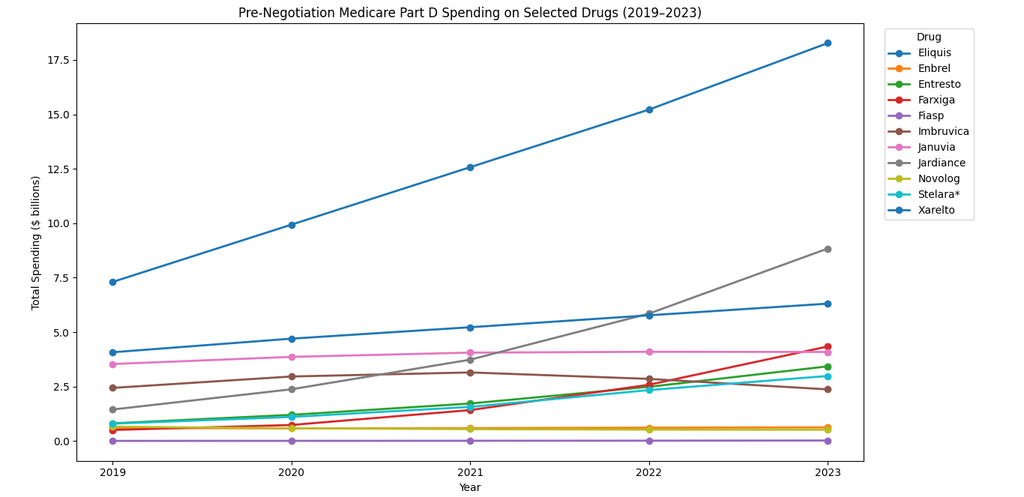
Eliquis accounted for the highest spending and is leading the chart. Its spending increased from around 7.5 billion to 18 billion between 2019 and 2023, making it the highest-spending drug among selected drugs. Xarelto is in second place, with its spending increasing from 4 billion in 2019 to around 6 billion in 2023. Januvia spending was around 3.5 billion in 2019 and increased to 4 billion in 2023.
Both Jardiance and Farxiga showed substantial spending growth. Jardiance spending increased from around 1.4 billion in 2019 to 8.8 billion in 2023. Farxiga followed a similar trend, with its spending increasing from 0.5 billion in 2019 to 4.3 billion in 2023.
Both Imbruvica and Enbrel showed varying trends. Initially, Imbruvica spending increased from 2.4 billion to 3.2 billion (2019-2021), followed by a decline in the following years. Its spending ended up at around 2.4 billion in 2023. Enbrel showed modest growth in overall spending.
Entresto and Stelara spending increased over the years. Entresto spending increased from 0.8 billion in 2019 to 3.4 billion in 2023. Stelara showed similar growth, with spending increasing from 0.8 billion in 2019 to 3 billion in 2023. The asterisk sign(*) in Stelara represents multiple dosage forms.
Novolog saw an overall decrease in spending from 0.7 billion in 2019 to 0.5 billion in 2023. Fiasp is a newer Novolog formulation with Niacinamide. Interestingly, Fiasp spending increased from 6.1 million in 2019 to 23.9 million in 2023.
Utilization of Negotiated Drugs (2019-2023)
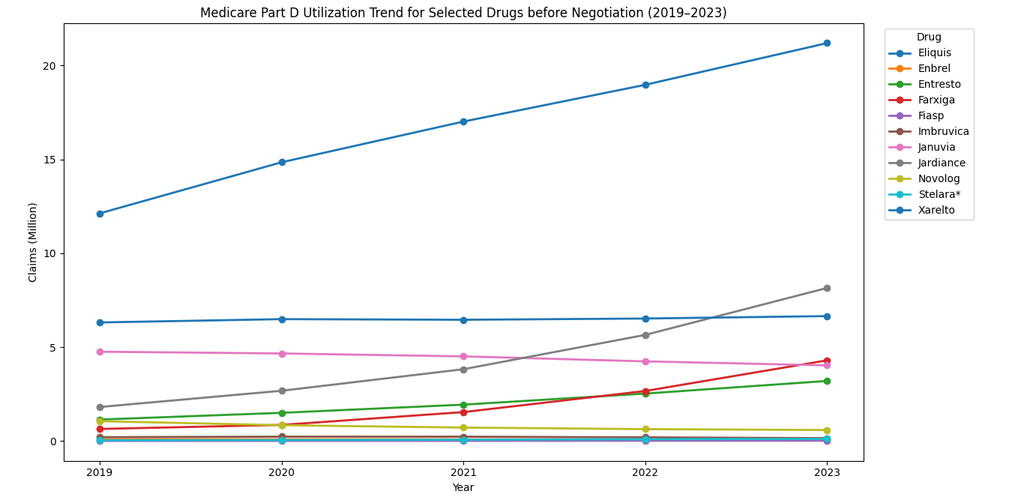
Eliquis had the highest claims in the group. Its claims increased from 12.1 million in 2019 to about 21.2 million in 2023. Xarelto showed a variation in trend, with claims slightly decreasing in 2021 and then modestly increasing. Claims increased from 6.3 million in 2019 to 6.7 million in 2023. Jardiance claims increased from around 1.8 million in 2019 to 8.2 million in 2023.
Farxiga claims rose from 640 thousand in 2019 to about 4.3 million in 2023. Entresto followed a similar trend, with its claims increasing from 1.1 million in 2019 to 3.2 million in 2023. Stelara claims increased from around 41 thousand to around 117 thousand.
Januvia showed a decreasing trend. Its claims decreased from around 4.8 million in 2019 to around 4.0 million in 2023. Imbruvica claims decreased from 206 thousand to 152 thousand between 2019 and 2023. Enbrel showed a similar trend, with its claims decreasing from 100 thousand in 2019 to 82 thousand in 2023.
Novolog claims declined from 1.1 million in 2019 to around 586 thousand in 2023. However, Fiasp claims increased from around 6 thousand in 2019 to 18 thousand in 2023.
What do the charts tell us?
Some key takeaways from the above charts are:
- Spending was concentrated in a few drugs. Eliquis had the highest spending amount among the selected drugs, highlighting the uneven distribution of spending across the selected drugs.
- Some drugs grew both in spending and utilization. Eliquis, Jardiance, Farxiga, and Entresto increased in both spending and utilization. This trend suggests that increased prescription utilization likely contributed to higher spending for some drugs.
- There is variation in trends. Imbruvica spending rose through 2021 and declined afterwards. Januvia and Novolog showed a decline in both spending and utilization. This reinforces that trends varied by product.
These trends establish a historical baseline for evaluating the effects of negotiated prices on the selected drugs. It doesn’t establish the effect of negotiation on overall spending, as the data ends in 2023 while negotiated prices came into effect in 2026. The analysis also cannot assess the impact of the $2,000 annual out-of-pocket cap, which took effect in 2025. However, the $35 monthly insulin cost-sharing limit was applied in the final year of analysis, i.e., 2023.
Conclusion:
Inflation Reduction Act (IRA) was enacted by the Federal government in 2022. It introduced major changes in Medicare Part D by changing the financial structure. Some key provisions include price negotiation, an annual out-of-pocket cap for beneficiaries, and a monthly cost-sharing limit for covered insulin products. Initially, ten drugs were chosen for price negotiation, and their prices came into effect on January 1, 2026. The analysis focused on these ten drugs before the negotiated prices were applied.
The dataset (2019-2023) showed varying spending and utilization trends across the selected drugs. Eliquis had the highest spending and utilization. Jardiance, Farxiga, and Entresto showed substantial growth in both spending and utilization. Other drugs showed variation in trends, while Januvia and Novolog showed a decline in both spending and utilization.
The historical analysis provided a useful baseline for examining the pre-negotiation effect. The effect of negotiated prices was not established because the data’s final year is 2023, while negotiated prices were effective in 2026. Future data analysis would provide insights about the impact of negotiation on overall Medicare spending.
Methodology Appendix:
Data Source:
- CMS Medicare Part D Spending By Drug Dataset (2019-2023)
Drug Selection:
- Eliquis
- Enbrel
- Farxiga
- Fiasp/Novolog
- Entresto
- Imbruvica
- Januvia
- Jardiance
- Stelara
- Xarelto
Metrics:
Total Spending: Sum of annual spending for selected drugs
Utilization: Sum of claims per year for selected drugs.
Limitations:
- CMS data ends in 2023, and neither includes negotiated prices that take effect in 2026 nor the $2000 out-of-pocket cap, which was effective in 2025.
- The $35 insulin cost-sharing limit took effect in 2023, overlapping the final year of the study.
- Spending and claims trends alone cannot establish why changes occurred or measure policy effectiveness.
References:
[1] Congressional Budget Office. Developments in CBO’s Projections for Medicare Part D. 2026. CBO report.
Leave a Reply