Medicare Part D aims to provide financial assistance to people, enabling them to buy prescribed drugs at reduced cost. It is available to people who are already part of the Medicare program. This drug coverage program effectively reduces the financial burden on the public.
The following post is an analysis of publicly available Medicare Part D drug spending data for the years 2019-2023. It may seem outdated, as we are currently in 2026. However, data collection and recordkeeping usually take years to complete. So, the data used for analysis is the latest available record published by the Centers for Medicare and Medicaid Services(CMS) on its official website.
Data analysis provides answers to the following questions:
- How has drug spending changed over the years?
- Which drugs account for the most expenditures?
- Which treatment options have gained popularity over time?
1. Drug Expenditures Over the Years:
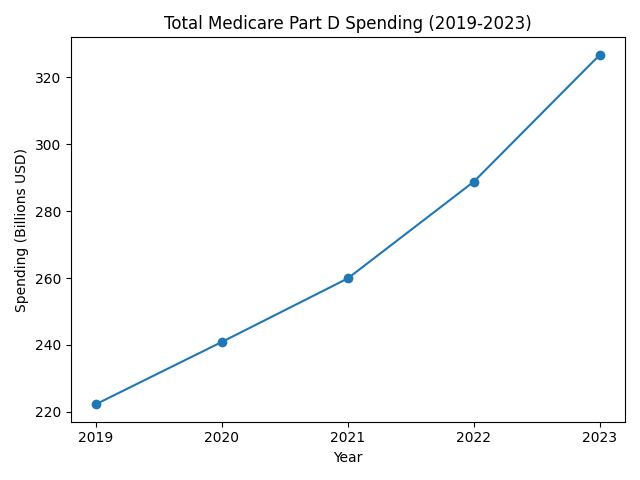
The graph above shows the increase in total drug expenditures over the years. In 2019, the total spending on drugs was around 220 billion. In 2020, it rose to approximately 240 billion.
In 2021, drug spending was around 260 billion, which increased to approximately 288 billion in the following year (2022), marking a significant rise in spending.
In 2023, spending rose to around 326 billion, which shows an increase of almost 38 billion from the previous year.
Overall, the trend has shown consistent growth without exception. The comparison of the earliest year (2019) with the latest year (2023) showed that spending increased by approximately 106 billion over five years.
2: Top 10 Drugs in the Year 2023:
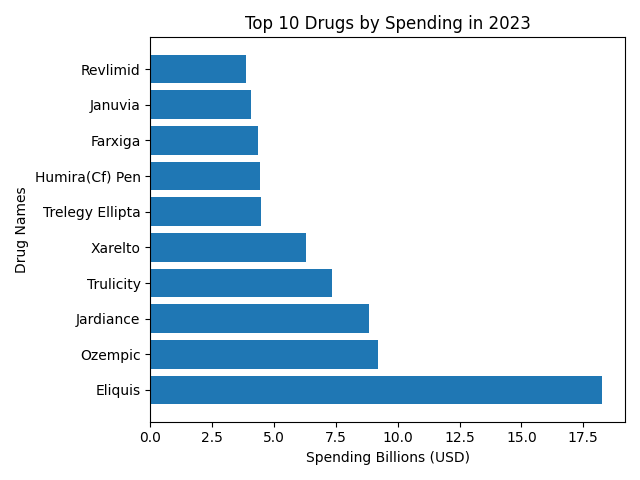
| DRUG NAME | COST (Billions USD) approx. |
|---|---|
| Eliquis | 18.3 |
| Ozempic | 9.2 |
| Jardiance | 8.8 |
| Trulicity | 7.4 |
| Xarelto | 6.3 |
| Trelegy Ellipta | 4.5 |
| Humira(Cf) Pen | 4.4 |
| Farxiga | 4.3 |
| Januvia | 4.1 |
| Revlimid | 3.9 |
Eliquis tops the list, showing a total cost of around 18.3 billion, followed by Ozempic. It is interesting to note that Ozempic spending is almost half of Eliquis. This might change in the coming years as Ozempic has become a popular choice of drug due to its additional benefit of weight loss.
Three drugs in the top five are used in diabetes management (Ozempic, Jardiance, and Trulicity). Apart from these, both Januvia and Farxiga are also used in diabetes management. Thus, five drugs in the list of the top ten are anti-diabetics. This pattern indicates the disease burden in beneficiaries of the Medicare program.
Eliquis and Xarelto are the other two drugs ranking among the top five. Both of them are anticoagulants. Their presence in this list might indicate the prevalence of cardiovascular diseases. However, increased usage of these drugs could also be linked to preventing clot formation in patients who have undergone surgery.
3: Absolute Growth of Drugs (2019-2023):
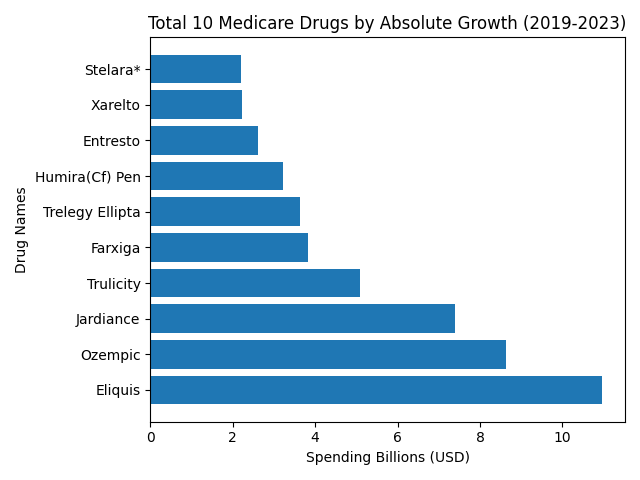
| DRUG NAME | GROWTH (Billions USD) approx. |
|---|---|
| Eliquis | 11.0 |
| Ozempic | 8.6 |
| Jardiance | 7.4 |
| Trulicity | 5.1 |
| Farxiga | 3.8 |
| Trelegy Ellipta | 3.6 |
| Humira(Cf) Pen | 3.2 |
| Entresto | 2.6 |
| Xarelto | 2.2 |
| Stelara* | 2.2 |
The analysis of absolute growth in billions over the years reveals some interesting insights. The top four drugs showing maximum growth are in the same spot in the list of the top ten drugs in the year 2023. The asterisk(*) in the drug name “Stelara*” represents multiple routes of administration, i.e., subcutaneous injection (SC) and intravenous infusion (IV).
1: Eliquis:
Eliquis (apixaban) is a blood-thinning drug used for the prevention of blood-clot formation in atrial fibrillation and in people who have undergone hip or knee replacement surgery. It might also be used as an initial treatment for pre-formed clots and to prevent them from developing again.
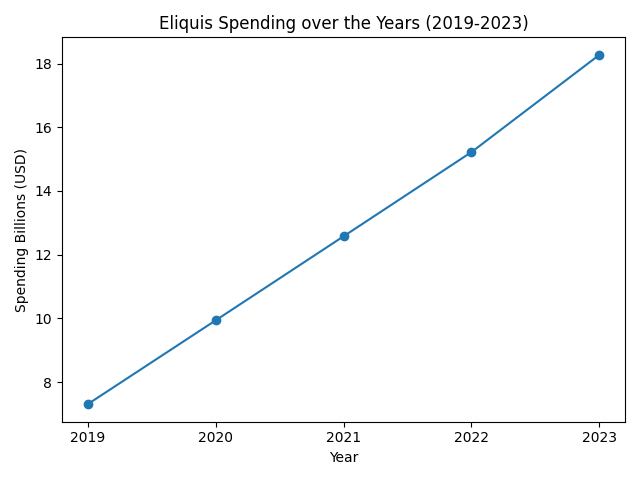
The graph represents a consistent elevation in Eliquis spending over the years, suggesting its preference over other anticoagulants. It might be due to the reduced risk of bleeding relative to other anticoagulants such as Warfarin.
2: Ozempic:
Ozempic(semaglutide) is a GLP-1 receptor agonist used in diabetes management and to reduce the risk of end-organ damage. It increases insulin levels in the body by lowering sugar release from the liver. It also reduces stomach emptying, which in turn lowers appetite and increases fullness.
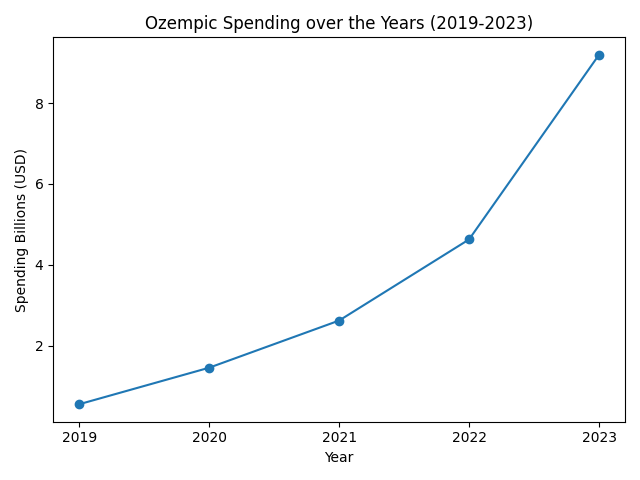
Ozempic’s chart shows consistent growth till the year 2022, followed by a sharp spike in the year 2023. This increase could be attributed to the drug’s weight loss effect and rising popularity among the masses.
3: Jardiance:
Jardiance(empagliflozin) is used in the management of type 2 diabetes and lowers the risk of cardiovascular problems in diabetics. It belongs to the drug class of SGLT-2 inhibitors. It acts on SGLT proteins located in the kidneys by blocking them. By blocking these proteins, glucose is not reabsorbed into the bloodstream, leading to lower blood glucose levels.
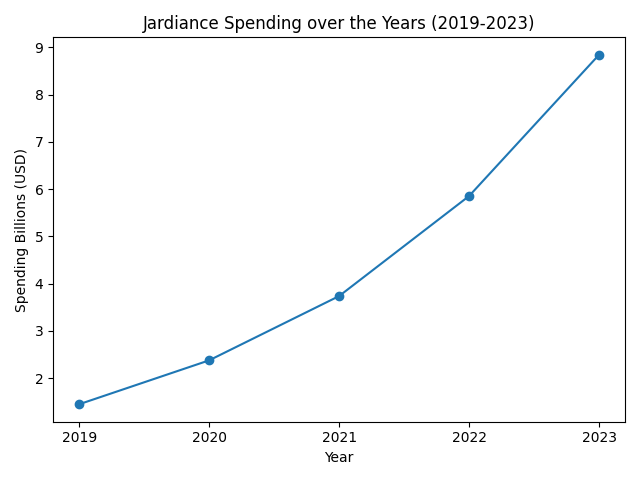
Jardiance’s growth pattern is similar to that of Ozempic’s. There is a consistent rise followed by a spike in 2023. The increased spending growth could be due to its efficacy in the treatment of chronic kidney disease (CKD) and heart failure for patients (both diabetic and non-diabetic).
4: Trulicity:
Trulicity(dulaglutide) is used to treat type 2 diabetes mellitus. It also reduces the risk of heart attack or stroke in diabetics with cardiovascular disease.
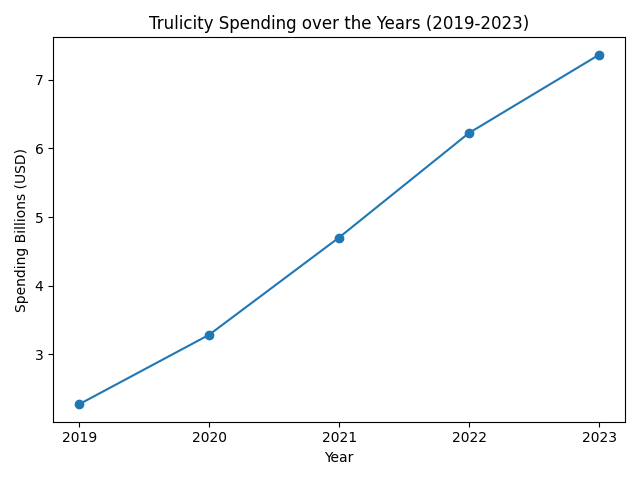
The graph of Trulicity shows a consistent increase in growth without any spikes. Unlike Ozempic, it does not have a weight-loss effect. However, Trulicity is well-tolerated in the long term due to its fewer side effects, giving it a slight edge over Ozempic.
Conclusion:
The Medicare drug coverage program has expanded over the years and has shown a consistent increase in spending for years (2019-2023).
The data revealed that a small number of drugs account for a large part of expenditures. It demonstrated the cardiovascular and metabolic disease burden on the public.
Limitations:
While data analysis of the Medicare Part D provides some useful insights, it is limited in scope.
- It represents only a small part of the pharmaceutical market and doesn’t represent the general public.
- This analysis is based on Brand names and doesn’t take generic names into account.
- It doesn’t consider other factors, such as Medicare’s budget, price changes, availability, and preferences.
- There is no comparison with other similar programs, such as Medicaid.
Disclaimer: This article is a personal exploration piece and is intended for informational/educational purposes only.
Leave a Reply