The previous analysis revealed that a large portion of Medicare Part D spending was concentrated in a small number of drugs. Among all drug classes, GLP-1 agonists emerged as a clear winner. In this post, we will examine the contribution of GLP-1 drugs to Medicare Part D spending over the years (2019-2023).
Introduction:
GLP-1 agonists are primarily used to treat type 2 diabetes. Some of these drugs have an additional benefit of weight loss and might be used to treat obesity. Some examples are:
- Ozempic
- Trulicity
- Rybelsus
- Victoza
This drug class has become one of the fastest-growing classes of prescription drugs and a major contributor to Medicare Part D spending.
GLP-1 Agonists Medicare Spending:
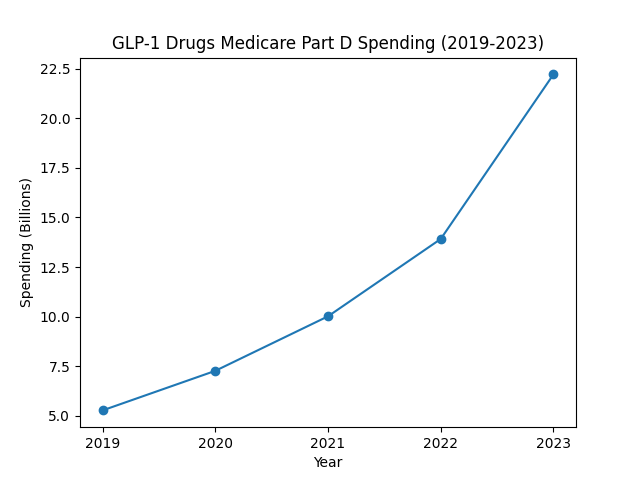
The graph reveals consistent growth in expenditure on GLP-1 drugs over the years. A clear spike is seen from 2022 to 2023. In 2022, $13.9 billion was spent on these drugs, which increased to around $22.2 billion in 2023. This significant increase could be linked to their effectiveness in treating obesity.
Percentage Growth of GLP-1 Drugs:
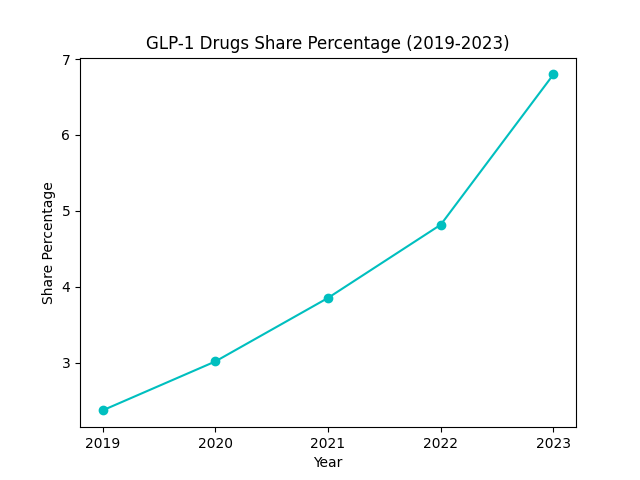
The line chart shows the percentage share of GLP-1 drugs in total Medicare spending. In 2019, it was 2.4%, increasing to 6.8% in 2023. It suggests that Medicare coverage is expanding and is including newer therapies in the program. Or it could be an indicator of increasing disease burden in the public.
Let’s look into the factors behind the rising expenditures. Increased spending could be linked to multiple factors, i.e., greater utilization, price per prescription, or both.
Utilization of GLP-1 Drugs:
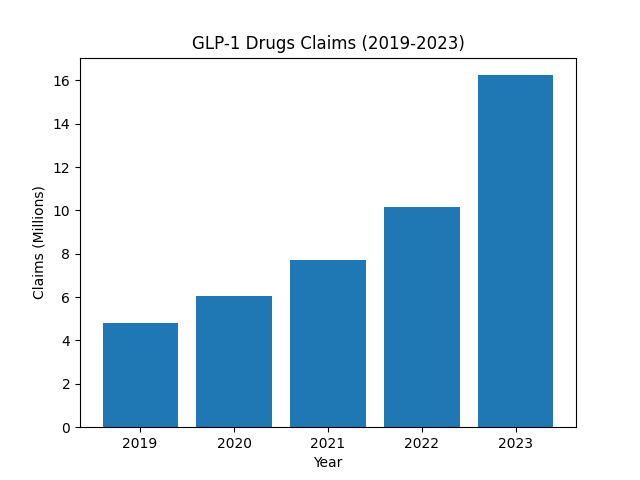
The graph shows a consistent increase throughout the years. Total claims rose to 16 million in 2023 from almost 10 million in 2022. This impressive rise suggests that utilization plays a key role in the increased GLP-1 spending.
Cost Per Prescription:
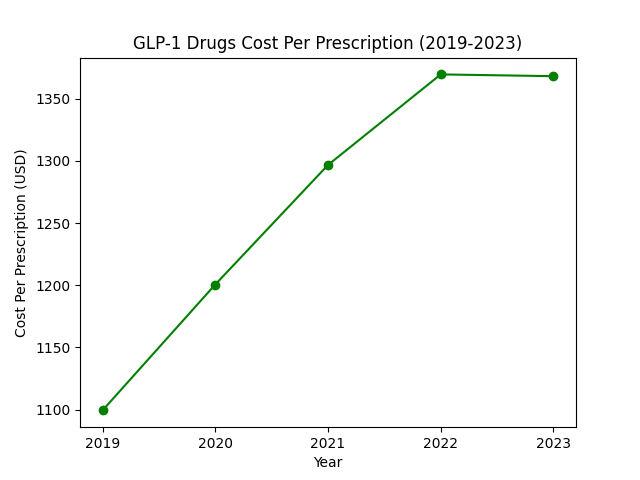
The cost-per-prescription chart for collective GLP-1 drugs showed that prices consistently increased until 2022. Interestingly, there is a slight decline in 2023. However, these drugs are more expensive than other drug classes, making them a significant contributor to total Medicare Part D spending.
Thus, the increase in GLP-1 drugs’ expenditure could be primarily linked to increased utilization. An increase in cost is a relatively less significant factor.
It raises the question whether growth is concentrated or evenly distributed across all the GLP-1 drugs.
Top Five GLP-1 Drugs in Medicare Part D:
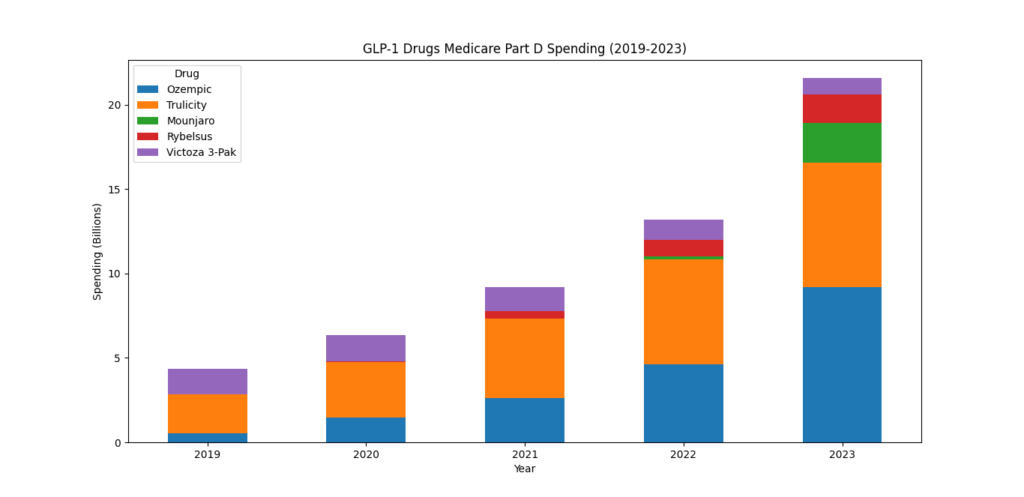
The stacked bar chart reveals the top five GLP-1 drugs in Medicare Part D spending (2019-2023). From 2019 to 2022, Trulicity was leading, followed by Victoza 3-Pak in 2019 and 2020. Ozempic became second on the list from 2021 onwards. Rybelsus has shown consistent growth. Mounjaro entered the chart in 2022. It is classified as a dual GIP/GLP-1 agonist.
The bar for 2023 shows Ozempic taking the first spot from Trulicity. Victoza 3-Pak has shrunk in the years 2022 and 2023.
The graph shows that a smaller number of GLP-1 drugs account for a large portion of total GLP-1 Medicare spending.
GLP-1 drugs’ Medicare Part D findings could be summarized as:
| Year | Total Spending ($B) | Total Claims (M) | Cost Per Prescription ($) | Share of Medicare Spending (%) |
|---|---|---|---|---|
| 2019 | 5.2 | 4.8 | 1099 | 2.4 |
| 2020 | 7.2 | 6.1 | 1201 | 3.0 |
| 2021 | 10.0 | 7.7 | 1297 | 3.9 |
| 2022 | 14.0 | 10.2 | 1370 | 4.8 |
| 2023 | 22.2 | 16.2 | 1368 | 6.8 |
Conclusion:
GLP-1 agonists form a significant portion of total Medicare Part D spending. GLP-1 drug spending has increased from $5.2 billion in 2019 to $22.2 billion in 2023. Both cost and utilization contribute to increased spending. However, utilization is a relatively significant contributor to the increased expenditure.
Spending is concentrated in a small number of drugs. Ozempic is leading the chart, followed by Trulicity. Rybelsus has shown consistent growth. Mounjaro was added later in 2022. Victoza 3-pak has slowed in growth.
The analysis revealed that GLP-1 drugs are a significant part of Medicare Part D spending. Their increased popularity could be attributed to their effectiveness in both type 2 diabetes and obesity.
Methodology Appendix:
Data Source:
CMS Medicare Part D Spending By Drug Dataset (2019-2023)
Drug Selection:
The following drugs were included in the analysis:
- Bydureon Bcise
- Bydureon Pen
- Byetta
- Mounjaro
- Ozempic
- Rybelsus
- Saxenda
- Trulicity
- Victoza 2-Pak
- Victoza 3-Pak
- Wegovy
Metrics:
Total GLP-1 Spending: Sum of annual spending of selected GLP-1 drugs.
Top five GLP-1 Spending: Annual spending aggregated by drug and ranked by spending.
Utilization: Sum of GLP-1 claims for each year.
GLP-1 Share of Medicare Spending:
Cost Per Prescription:
Limitations:
- It is a collective analysis of GLP-1 drugs and is not based on individual drugs.
- It is limited in scope and does not include the public at large.
- No patient data was included in the analysis.
- External factors such as budget and inflation were not considered.
Leave a Reply